
Dr Peter Symons was most appropriately our guest speaker on 3rd November, Melbourne Cup Day. Peter and our dear fellow member, Ian Fairnie, were great friends. Peter gave us a most entertaining presentation on why owners, trainers and jockeys race horses, and without pulling a Mr Ed trick, how do horses feel about chasing each other round the track?
Are methods used in training horses and jockeys urging their mounts on to win with whips and spurs to the horses’ liking? Are jockeys a necessary evil?
To illustrate this point, Peter showed us a video of the Japan Cup raced over 2400m. We were urged to watch the grey horse in particular, who lost its rider early in the race.
Other points we were quizzed on were a jockey’s appraisal of a typical race:
- Position
- Setting the right pace
- Where is the favourite?
- When do I go?
- When can I go?
Of course we were barracking for the grey horse (whose rider appeared unhurt in the fall). He started at the back and gradually made his way round the outside to take the lead.
Two ridden horses at the back also made their move and rounded the pack but they couldn’t catch the grey who crossed the line in one of the fastest times ever recorded over that distance.
The front runner who led the field until the final 200 metres couldn’t keep up the pace and finished somewhere in the middle.
The video demonstrated what Peter had told us about horses and jockeys: Horses like to run, it is part of their evolution and survival instinct to run from danger and as part of the herd; jockeys must read the race to set the pace for their horse if it is a stayer or a sprinter. The best outcome for any jockey is: “I had him lobbing beautiful.”
A trainer once told his jockey Jason who was riding at Ascot over 1600m: “If you stay on the rail and get beaten, that’s OK. If you run him outside and lose, I will kill you.” And from another: “You can’t work with horses, if you don’t like them.”
Peter’s father didn’t start training horses until the age of 60. He had a small number and trained his own horses and not for other owners. His horses were well looked after and enjoyed the exercise (they are natural athletes), green pastures, good food, and plenty of attention.
Peter gave credit to Racing WA’s chief vet who introduced a program to thoroughly test racehorses’ fitness before a race. At the time too many overseas horses were breaking down.
The horse undergoes four scans, and if anything is wrong, it is scratched, which protects the horse and the jockey. But trainers complained, saying the testing was too rigorous and should be more flexible. But if a horse is lame, how can a vet be more flexible with his decision? The chief vet resigned in protest, but Peter said he would like to nominate her for Veterinarian of the Year, because she kept to her principles and didn’t waver.
Peter concluded with a photo of Ian, who we especially remember on this day.
President Margaret said she had learnt a lot from Peter’s amusing presentation and Peter nominated my fascinator for “Hat of the Day”.
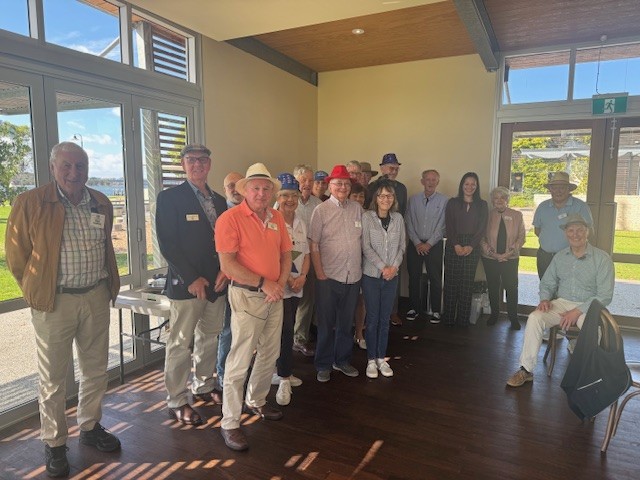
The Melbourne Cup Sweeps once again added plenty of fun and anticipation to our Melbourne Cup celebrations.
Sweep 1 Results
- 🥇 1st Place: Lorri Brazier - $65
- 🥈 2nd Place: Tony Haeusler - $35
- 🥉 3rd Place: George Mavros - $20
Sweep 2 Results
- 🏆 Winner: Jamie Kelly - $60
- 🐴 Last Place: John Kelly - $60
Congratulations to all our winners and thanks again to our resident bookie honest Mal for organising!